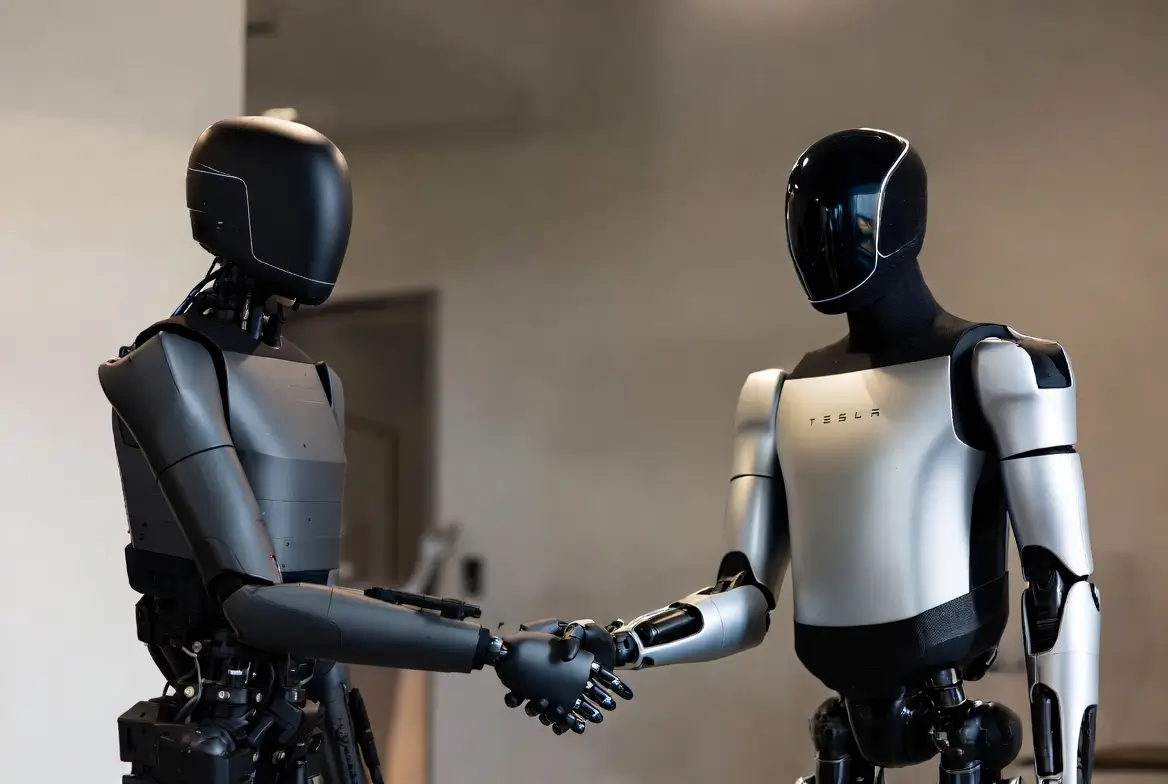
If you live on X (formerly Twitter), you'd think the only humanoid robot in existence is Tesla Optimus. Elon Musk's carefully choreographed videos of Optimus folding laundry or walking in a straight line garner millions of views.
But if you walk the factory floors of Shenzhen and Guangdong, you see a different story.
AgiBot, a Shanghai-based startup founded by a former Huawei genius, didn't just compete with Tesla in 2025—it beat them.
The Deployment Data
According to the 2026 Global Robotics Installation Report released this February, here is the breakdown of active, commercial usage of humanoid robots in 2025:
| Manufacturer | Units Deployed (2025) | Primary Sector | Cost Per Unit |
|---|---|---|---|
| AgiBot (X2/G2) | 5,200 | Logistics & Auto Mfg | $28,000 |
| Unitree (G1/H1) | 3,100 | Research & Education | $16,000 |
| UBTECH (Walker) | 1,800 | Auto Mfg (Nio/BMW) | $85,000 |
| Tesla (Optimus) | ~450* | Internal Beta (Texas) | N/A |
*Note: Tesla's numbers are estimates as they do not sell externally yet.
Why AgiBot Won (The "Good Enough" Strategy)
While Tesla Optimus is chasing "General Purpose Artificial Intelligence" (doing everything a human can do), AgiBot focused on Specialized Generalisation.
The AgiBot X2 isn't trying to cook dinner. It is trying to move a box from Pallet A to Conveyor B, 10,000 times a day, without falling over. And it does it perfectly.
By answering the specific needs of logistics giants like JD.com and Alibaba, AgiBot scaled production while Tesla was still fine-tuning hand dexterity.
The "End-to-End" Trap
Tesla's bet is on End-to-End Neural Networks—training a robot by simply showing it video, rather than programming it. This is the holy grail, and it's what we discussed in Alibaba Cloud OpenClaw.
However, End-to-End is notoriously hard to debug. AgiBot uses a hybrid approach: classic control theory for walking (stability) + AI for vision (object recognition). It's less "sexy" tech, but it ships.
The Future
Tesla is waking up. Reports suggest the Optimus Gen 3 Mass Production run will start in late 2026, aiming for 10,000 units.
But by then, AgiBot plans to have 20,000 units online. The race isn't about who has the smartest robot; it's about who has the most robots gathering real-world data data.
Right now, Shanghai is winning.

HapticFeed Team
Editorial Board
The collective voice of HapticFeed. A distributed group of engineers, designers, and researchers dedicated to tracking the pulse of tomorrow's technology. We write about what matters, not just what's trending.