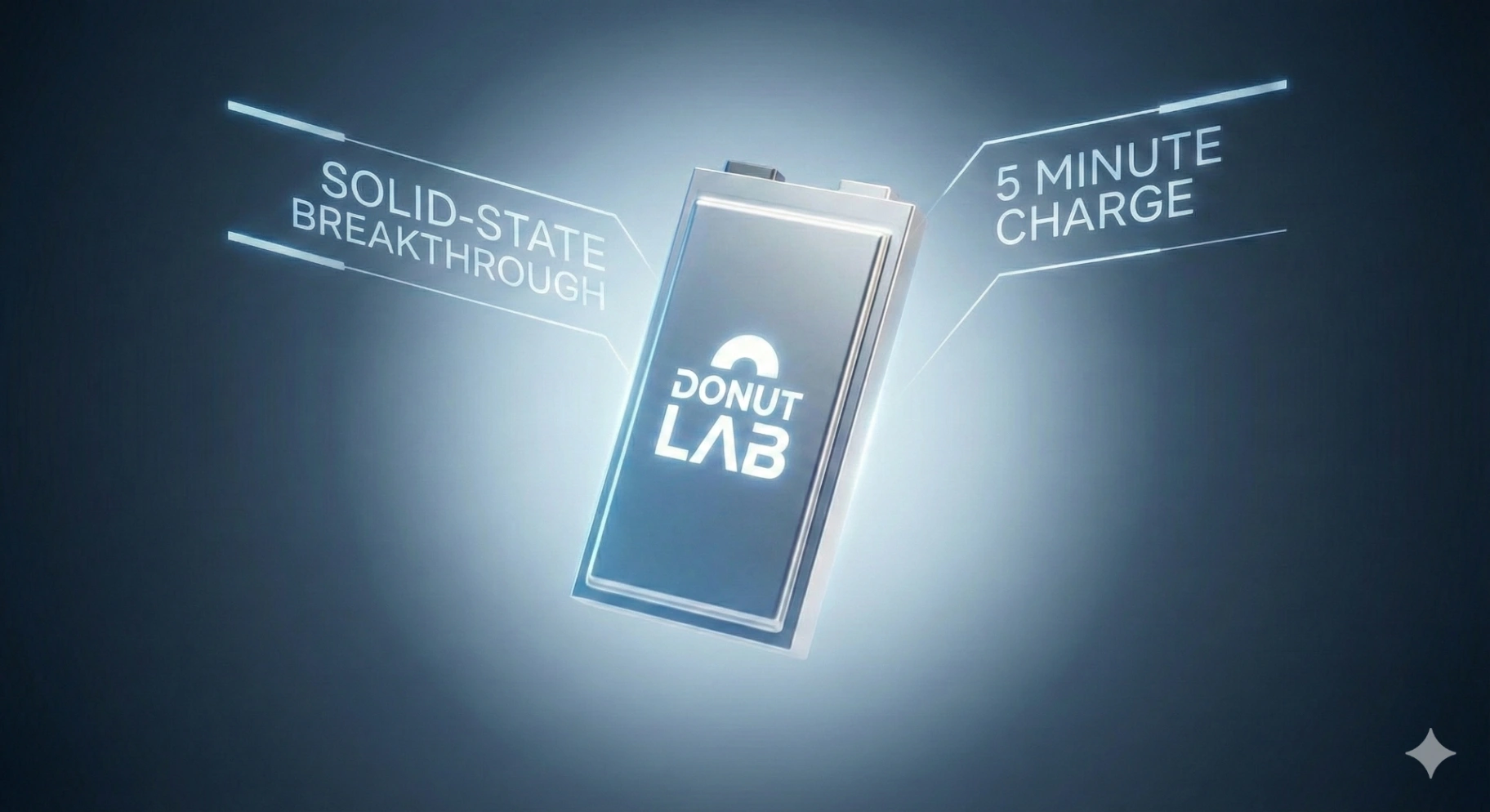
The Holy Grail of Batteries Is Here: Inside Donut Lab’s Solid-State Breakthrough
For decades, the "Holy Grail" of electric vehicle technology has been the solid-state battery. Promises of lighter packs, instant charging, and zero fire risk have always been "five years away." At CES 2026, a Finnish startup named Donut Lab shattered that timeline, announcing not just a prototype, but a production-ready cell shipping this quarter.
Shattering the Performance Ceiling
The specifications released by Donut Lab are nothing short of revolutionary. While traditional Lithium-Ion batteries struggle to balance energy density with safety, Donut Lab’s new architecture reportedly delivers on all fronts without compromise.
The headline figure is an energy density of 400 Wh/kg. To put that in perspective, this allows for battery packs that are nearly half the weight of current market leaders for the same range. Perhaps even more impressive is the charging speed: a 0 to 100% charge in just five minutes. Unlike current EVs that slow down charging speeds after 80% to protect the battery, Donut Lab claims their chemistry handles the full power curve without degradation.
Reliability and Safety
Longevity is where the claims become truly disruptive. Typical EV batteries are rated for roughly 1,500 to 2,000 charge cycles before they lose significant capacity. Donut Lab is quoting a design life of 100,000 cycles. If validated, this essentially means the battery would outlast the vehicle itself—and potentially the next ten vehicles you own.
Safety is also intrinsic to the design. By removing the flammable liquid electrolyte found in traditional cells, the battery is reportedly immune to thermal runaway (fires) and dendrite formation (short circuits), functioning reliably in temperatures ranging from -30°C to +100°C.
Real-World Application: Verge Motorcycles
Skepticism is natural in an industry filled with "vaporware," but Donut Lab has a distinct advantage: a shipping product. The technology is not sitting in a lab; it is being integrated into the Verge TS Pro electric motorcycle, hitting roads in Q1 2026.
This immediate commercial application puts the industry on notice. While giants like Toyota and Volkswagen have targeted 2027–2030 for mass production, Donut Lab claims to have crossed the finish line today.
The Verdict
While we await independent teardowns to verify the chemistry—rumored to involve amorphous Titanium Dioxide developed with Nordic Nano—the implications are staggering. If Donut Lab delivers on these promises, the era of range anxiety and battery degradation is officially over.
2026 might just be the year the electric revolution finally grew up.