The Ultimate Hard Drive: Storing the Entire Internet in a Shoebox
By 2026, humanity generates roughly 400 quintillion bytes of data every single day. We are building massive, energy-hungry data centers just to house our cat videos, log files, and scientific records. But there is a physical limit to how small we can make a transistor or how dense we can pack a hard drive platter.
Nature, however, solved the storage problem billions of years ago. The answer is not silicon; it's DNA.
The Crash Course: Binary to Quaternary
Computers understand Binary: a stream of 0s and 1s.
Biology understands Quaternary: a stream of four chemical bases—Adenine (A), Cytosine (C), Guanine (G), and Thymine (T).
The core concept of DNA storage is simple translation. We can map binary code directly to these biological bases. For example:
00→ A01→ C10→ G11→ T
Therefore, a digital sequence like 01 11 00 10 becomes the biological strand CTAG.
Why DNA Wins: Density and Durability
The numbers surrounding DNA storage are difficult to comprehend because they are so vast.
1. Extreme Density A typical hard drive is 2D—data sits on a flat platter. DNA is 3D. You can pack molecules into a volume.
- Hard Drive: ~1 Terabyte per square inch.
- DNA: ~215 Petabytes per gram. Theoretically, all the data currently in existence globally could fit inside a single shoebox filled with DNA.
2. The 1000-Year Archive Magnetic tape degrades in 30 years. SSDs lose their charge without power. DNA, if kept cool and dry, lasts for hundreds of thousands of years. We have sequenced DNA from woolly mammoths that died 10,000 years ago. It is the ultimate "Cold Storage."
How It Works (The Read/Write Cycle)
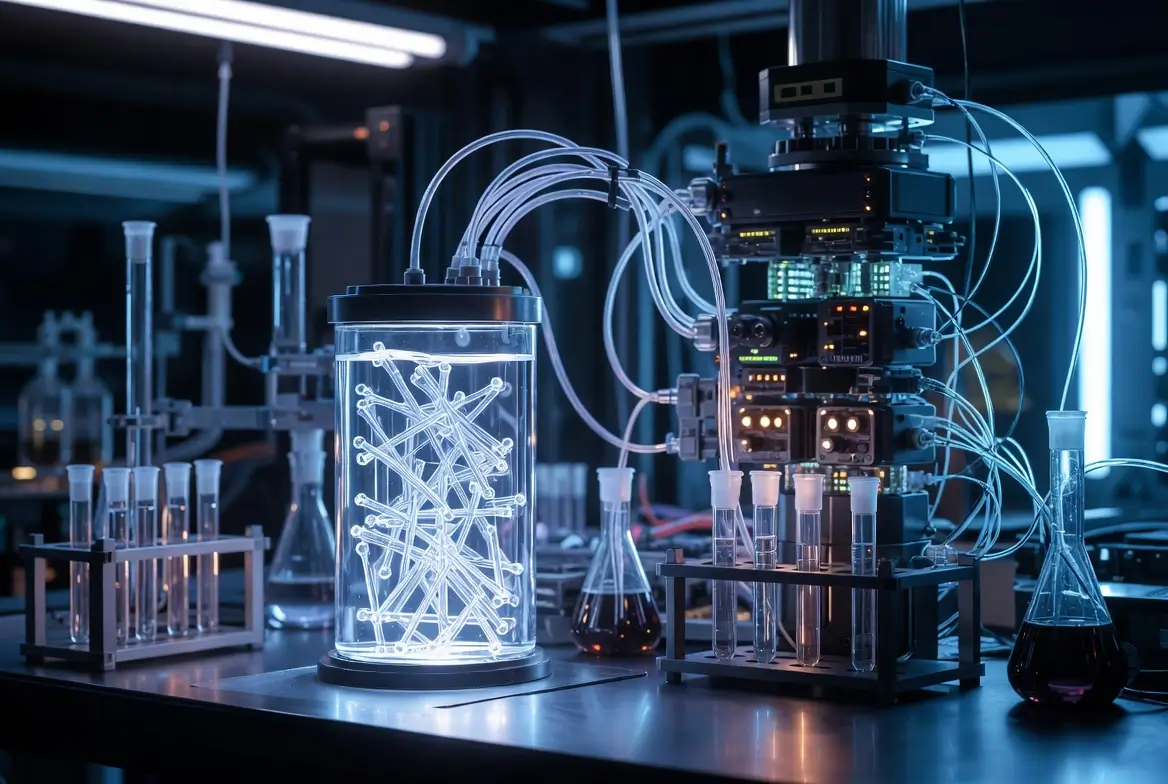
This isn't a drive you plug into USB-C (yet). The process is chemical:
- Encoding (Writing): An algorithm converts the file (image.jpg) into a text string of ACGT.
- Synthesis: A machine explicitly "prints" these synthetic DNA strands, base by base. This is currently the bottleneck—it is slow and expensive.
- Storage: The DNA is put into a tiny vial and stored. It consumes zero energy.
- Sequencing (Reading): To read the file back, we use a DNA sequencer (the same machines used for medical tests) to read the order of the bases.
- Decoding: The computer translates the ACGT back into binary, and your file opens.
The Catch: Latency
You won't be running Cyberpunk 2077 off a DNA drive. The read/write speeds are measured in hours, not milliseconds. DNA is destined to replace the magnetic tape archives used by banks and governments, not your SSD.
But as synthesis costs drop (following a curve faster than Moore's Law), the biological hard drive is moving from science fiction to the enterprise data center.